
Stories have a special way of reaching a child’s heart. Through memorable characters and simple situations, Moral Stories help children understand honesty, kindness, patience, truthfulness, courage, and responsibility. The lessons stay with them because they see how a character’s choices lead to positive or negative consequences.
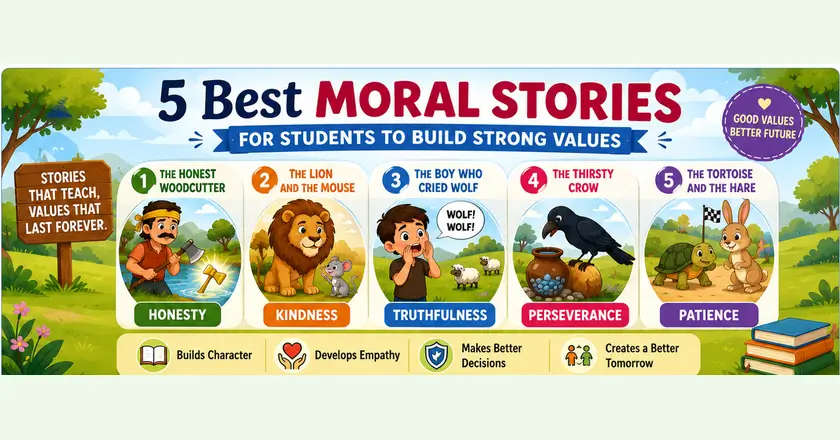
5 Moral Stories with Morals
The following Moral Stories for Students are suitable for classroom reading, storytelling sessions, assemblies, and family conversations. Each story introduces an important value through events that children can easily understand and remember.
1. The Honest Woodcutter: Learning the Value of Honesty
A poor woodcutter earned his living by cutting wood near a river. One day, his axe slipped from his hands and fell into the deep water. He sat by the river, worried because he could not afford another axe.
A magical figure appeared and offered to help. First, she showed him a golden axe. The woodcutter honestly said that it was not his. She then brought a silver axe, but he again refused it. Finally, she returned with his old iron axe. The woodcutter happily recognised it as his own.
Impressed by his honesty, she rewarded him with all three axes.
Moral: Honesty earns trust and brings lasting rewards.
This story works especially well among Bedtime Moral Stories because parents can ask children whether they would have chosen the golden axe or spoken the truth.
Life Lesson:
Honesty is always rewarded. We should tell the truth even when we have an opportunity to gain something more.
Ask the Children:
What do you learn from the woodcutter’s honesty? What would you have done in his situation?
2. The Lion and the Mouse: A Lesson in Kindness
One afternoon, a lion was sleeping peacefully when a little mouse accidentally ran across his body. The angry lion caught the mouse and prepared to eat him. The frightened mouse begged for freedom and promised to help the lion someday.
The lion laughed at the idea that such a tiny creature could help him, but he decided to show mercy and let the mouse go.
A few days later, hunters trapped the lion in a strong net. Hearing his roars, the mouse rushed to help. He chewed through the ropes until the lion was free.
The lion realised that even the smallest friend could offer valuable help.
Moral: Kindness is never wasted, and everyone has something valuable to offer.
Life Lesson:
Kindness is never wasted. Even the smallest person can make a big difference and help others in meaningful ways.
Ask the Children:
What did the lion learn from the little mouse? How can you show kindness to others?
3. The Boy Who Cried Wolf: Understanding the Importance of Truth
A young shepherd looked after sheep near his village. Feeling bored, he decided to play a trick. He shouted, “Wolf! Wolf!” and watched the villagers rush to help him.
When they discovered there was no wolf, the boy laughed.
He repeated the same trick another day. The villagers warned him not to lie, but he ignored them.
Soon, a real wolf appeared and attacked the flock. The boy cried for help with all his strength, but nobody came because they believed he was lying again.
The boy finally understood that his repeated dishonesty had destroyed people’s trust.
Among the most memorable Moral Stories in English, this tale shows children that trust takes time to build but can be lost through one careless habit.
Moral: People may not believe a habitual liar, even when that person tells the truth.
Life Lesson:
Always speak the truth. Repeated lies can destroy trust, and people may not believe you even when you are telling the truth.
Ask the Children:
Why did the villagers stop believing the boy? What should he have done instead of lying?
4. The Thirsty Crow: Learning Creativity and Perseverance
On a hot summer day, a thirsty crow flew from place to place searching for water. After a long search, he found a pot with a small amount of water at the bottom. He tried to reach it with his beak, but the water level was too low.
Instead of giving up, the crow looked around and noticed several small stones. He picked them up one by one and dropped them into the pot. With every stone, the water rose slightly.
After patiently adding enough stones, the water came within reach. The clever crow drank it and flew away refreshed.
This is one of the finest Stories with Moral Values for showing that calm thinking and steady effort can solve difficult problems.
Moral: Creativity, patience, and perseverance help us overcome challenges.
Life Lesson:
Creativity, patience, and perseverance can help us overcome challenges. We should think calmly and keep trying instead of giving up.
Ask the Children:
How did the crow solve the problem? What can you do when something seems difficult?
5. The Tortoise and the Hare: The Power of Patience and Consistency
A hare often made fun of a tortoise for walking slowly. Tired of the teasing, the tortoise challenged him to a race. The hare quickly moved far ahead and became certain that he would win.
Feeling overconfident, he decided to rest under a tree. He soon fell asleep. Meanwhile, the tortoise continued walking at a slow but steady pace. He did not stop, complain, or lose focus.
By the time the hare woke up and rushed towards the finish line, the tortoise had already won.
Moral: Consistent effort is more dependable than speed without discipline.
Life Lesson:
Patience, consistency, and determination lead to success. Steady effort is more valuable than speed without focus.
Ask the Children:
Why did the tortoise win the race? What does this story teach us about staying focused and consistent?
Important Life Lessons Children Can Learn from These Stories
Children can learn several valuable lessons from these timeless tales:
- Speak the truth even when honesty feels difficult.
- Treat everyone with kindness and respect.
- Think calmly when facing a problem.
- Do not underestimate another person’s abilities.
- Work consistently instead of depending only on talent.
- Understand that actions always have consequences.
The top CBSE schools in Bangalore can use storytelling, role play, reflection journals, and classroom discussions to help students connect these lessons with real-life situations.
How Moral Stories Build Empathy and Good Character
Stories allow children to see a situation through another person’s eyes. They imagine the woodcutter’s worry, the mouse’s fear, the shepherd’s regret, and the tortoise’s determination. This develops empathy and encourages children to think before judging or hurting others.
The best play schools in Bangalore can introduce such lessons through puppets, picture books, dramatic play, movement, and simple follow-up questions suited to young learners.
Simple Ways Parents Can Discuss Story Lessons at Home
Parents can make storytelling more meaningful by asking open-ended questions such as:
- Which character did you like most?
- What mistake did the character make?
- What would you have done differently?
- Have you faced a similar situation?
- How can we practise this value tomorrow?
The best CBSE schools in Bangalore also benefit when families continue value-based conversations at home, creating consistency between classroom learning and everyday behaviour.
Why Moral Stories Are Important for Children
Moral stories play an important role in shaping a child’s character, behaviour, and understanding of the world. Through simple and engaging narratives, children learn valuable lessons about honesty, kindness, courage, patience, responsibility, and respect. These stories help young readers understand the difference between right and wrong in a way that is easy to remember and apply in everyday life.
Moral stories also strengthen imagination, language skills, empathy, and critical thinking. As children relate to the characters and their choices, they learn to understand different emotions and consider the consequences of their actions. Whether shared at bedtime, in the classroom, or during family conversations, moral stories encourage positive behaviour and help children grow into thoughtful, compassionate, and responsible individuals.
Making Storytelling Fun and Meaningful for Children
Parents and teachers can use different voices, expressions, drawings, puppets, costumes, or simple props while narrating. Children may retell the story, change its ending, draw their favourite scene, or act as one of the characters. These activities improve listening, speaking, imagination, and memory.
Inspiring Positive Behaviour Through Timeless Moral Stories
A story alone may not change behaviour immediately, but regular storytelling can gently shape a child’s thinking. Adults should also model the same values by apologising when wrong, keeping promises, helping others, and responding patiently. Children understand a lesson best when they see it practised around them.
Building Strong Values Through Inspiring Moral Stories
Reading the 5 best moral stories for students helps children understand important values such as honesty, kindness, courage, responsibility, patience, and respect in a simple and memorable way. At Presidency School Bangalore East, moral stories are thoughtfully integrated into learning through storytelling sessions, classroom discussions, role plays, and reflective activities that encourage students to connect lessons with real-life situations. These meaningful stories not only improve imagination, vocabulary, and listening skills but also help young learners develop empathy, good judgement, and positive behaviour. By combining academic learning with value-based education, Presidency School Bangalore East nurtures responsible, compassionate, and confident individuals.
Conclusion
The Honest Woodcutter, The Lion and the Mouse, The Boy Who Cried Wolf, The Thirsty Crow, and The Tortoise and the Hare continue to remain meaningful because their lessons apply to everyday life. Through these simple tales, children learn to be honest, kind, thoughtful, patient, and responsible. When parents and teachers discuss the lessons instead of merely narrating the ending, storytelling becomes a powerful tool for character development.