
Zero may look like the simplest number, but its development was one of the greatest turning points in mathematical history. The most accurate answer to Who Discovered Zero First depends on what we mean by “zero.” Earlier civilisations used empty spaces or symbols as placeholders, but Indian mathematician Brahmagupta was the first known scholar to clearly treat zero as a number and establish rules for calculating with it.

Exploring the Origins of Zero in Mathematics
The History of zero did not begin with a single discovery made on one particular day. The idea developed gradually as people needed a way to show an empty position in written numbers. Without such a marker, it was difficult to distinguish between values such as 21, 201, and 2,001.
Timeline of the Discovery of Zero</h2>
| Period | Contribution |
| Babylonian Civilization | Used a placeholder symbol |
| Maya Civilization | Developed a zero symbol for calendars |
| 499 CE | Aryabhata advanced the place-value system |
| 628 CE | Brahmagupta defined zero as a number |
| 9th Century | Al-Khwarizmi spread Indian numeral |
| 1202 | Fibonacci introduced the Hindu-Arabic numeral system to Europe |
Why the Discovery of Zero Was Revolutionary
The Importance of zero in mathematics lies in its ability to represent nothing while still having a clear place and value within the number system. Zero made large calculations simpler, supported the decimal place-value system, and later became essential to arithmetic, algebra, calculus, computing, engineering, and science.
How Ancient Civilisations Represented Nothingness
The Zero number history includes contributions from more than one civilisation. Babylonian mathematicians used a placeholder mark within their positional system, while the Maya independently developed a symbol for an empty value in calendar calculations. However, these early forms did not always function as a complete number with established arithmetic rules.
India’s Contribution to the Development of Zero
Students asking who invented zero in India are usually directed towards Brahmagupta. Yet India’s contribution was a longer intellectual journey involving place value, symbols, language, astronomy, and calculation. Indian scholars developed a number system in which ten symbols could express values of any size according to their position.
Aryabhata and the Evolution of the Place-Value System

The Discovery of zero was supported by earlier progress in positional notation. Aryabhata, who completed the Aryabhatiya in 499 CE, used an advanced place-value approach for mathematical and astronomical calculations. Although he did not present the same complete arithmetic rules for zero later given by Brahmagupta, his work strengthened the system in which zero could develop.
Brahmagupta’s Mathematical Rules for Zero
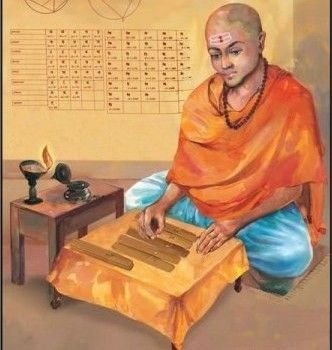
When people ask Who invented zero, Brahmagupta is often considered the best answer because his work moved zero beyond an empty position. In his Brahmasphutasiddhanta, written in 628 CE, he explained that subtracting a number from itself produces zero and gave rules for addition, subtraction, and multiplication involving zero and negative numbers.
Some of his important principles included:
- A number plus zero remains unchanged
- A number minus zero remains unchanged
- Zero minus zero equals zero
- A number multiplied by zero equals zero
- The sum of two zeros is zero
His ideas about division by zero were not completely correct by modern standards, but his effort was a major advance in mathematical reasoning.
How Zero Became a Number, Not Just a Placeholder
The Power of Zero became clear when mathematicians began treating it as an independent number rather than only a blank space between digits. As a number, zero could be included in equations, placed on a number line, and used in calculations involving positive and negative values.
How Zero Is Used in Everyday Mathematics
| Use of Zero | Simple Example |
| Represents nothing | 0 apples |
| Holds a place | 205 |
| Keeps a value unchanged | 8 + 0 = 8 |
| Produces zero in multiplication | 8 × 0 = 0 |
| Separates positive and negative numbers | −1, 0, 1 |
| Supports the decimal system | 10, 100, 1,000 |
The Journey of Zero from India to Europe
Indian numerals and calculation methods travelled to scholars in the Islamic world, where they were studied, developed, and shared through mathematical writings. Al-Khwarizmi’s work helped spread Indian arithmetic methods. The word “zero” is connected through linguistic changes to the Arabic word sifr, meaning empty.
In 1202, the Italian mathematician Fibonacci published Liber Abaci, introducing the Hindu-Arabic place-value system to a wider European audience. Although acceptance was slow, the new system eventually replaced more difficult methods based on Roman numerals for most calculations.
How Zero Transformed Arithmetic and Algebra
Zero made it possible to write very large and very small numbers efficiently. It also supported equations such as x + 5 = 5, in which the answer is zero. Algebra uses zero to identify roots, compare values, study graphs, and solve equations. Calculus, statistics, physics, and economics also depend on it.
Importance of Zero in Computers and Modern Technology
Computers work through binary code, which uses only two digits: 0 and 1. These digits represent different electronic states and allow devices to process text, images, sound, instructions, and data. Mobile phones, websites, artificial intelligence, digital payments, and satellites all rely on systems built around binary values.
Students at the best cbse schools in Bangalore can understand zero more deeply when teachers connect its history with place value, number lines, algebra, coding, and practical calculations. Such connections show that a familiar classroom number has shaped the modern world.
Common Myths About Who Discovered Zero
One common myth is that Aryabhata alone invented zero exactly as it is used today. His contribution to positional notation was highly significant, but Brahmagupta provided the earliest surviving systematic arithmetic treatment of zero as a number. Another misconception is that no civilisation understood empty value before India; earlier societies did use placeholders, although India took the concept much further.
The top cbse schools in Bangalore can help students avoid such oversimplifications by presenting mathematical discoveries as gradual developments. Inventions often emerge through the work of several thinkers, with later scholars improving and formalising earlier ideas.
Celebrating Zero as a Landmark Mathematical Discovery
- Zero teaches children that even “nothing” can have meaning. Teachers at the best play schools in Bangalore can introduce this idea through counting games, empty baskets, number cards, and simple place-value activities. These examples help young learners understand zero in a playful and practical way.
Zero deserves to be celebrated not only as a symbol but as a powerful mathematical idea. It connects ancient Indian scholarship with modern science and reminds students that curiosity, careful observation, and logical thinking can transform human understanding.
Interesting Facts About Zero
Some of the important and fun facts about “Zero”
- Zero is an even number.
- Zero is neither positive nor negative.
- Computers use only 0 and 1 to process information.
- The Roman numeral system had no symbol for zero.
- Zero is essential for modern science, engineering, and technology
Discovering the Fascinating Story Behind Zero
The question “Who discovered zero first?” introduces students to one of the most remarkable developments in mathematical history. Although early civilisations used symbols to represent an empty place, the ancient Indian mathematician Brahmagupta played a pioneering role by treating zero as an independent number and explaining how it could be used in calculations. At Presidency School Bangalore East, students are encouraged to explore such fascinating discoveries through engaging lessons, mathematical activities, and concept-based learning. By understanding the history and importance of zero, learners develop curiosity, logical thinking, and a deeper appreciation of how mathematics shapes science, technology, and everyday life.
Conclusion
No single person created every aspect of zero. Ancient civilisations used forms of empty-place notation, Aryabhata advanced positional calculation, and Brahmagupta gave zero a clear mathematical identity with arithmetic rules. From India, the number system travelled through the Islamic world and eventually reached Europe. Today, zero supports everything from basic calculations to computers, space technology, engineering, and artificial intelligence.