
Measurements are an important part of mathematics and daily life. Students use them while measuring height, length, classroom objects, furniture, craft materials, and spaces. Understanding Inches to Feet Conversion helps children compare measurements correctly and solve simple maths problems with confidence.
Understanding Inches and Feet in Measurement
Inches and feet are units used to measure length. An inch is a smaller unit, while a foot is a larger unit. A ruler, measuring tape, or height chart may show both units. Students often come across these measurements while learning maths, science, drawing, sports, and project work.
Why Inch to Feet Conversion Is Important for Students
An Inches to Feet Calculator can give quick answers, but students should also understand the method behind the calculation. This helps them solve exam questions, word problems, and real-life measurement tasks without depending only on digital tools.
Simple Formula to Convert Inches to Feet
The Inches to Feet Formula is very simple:
Feet = Inches ÷ 12.
This means that whenever students want to change a value from inches into feet, they need to divide the number of inches by 12.
How 12 Inches Make 1 Foot
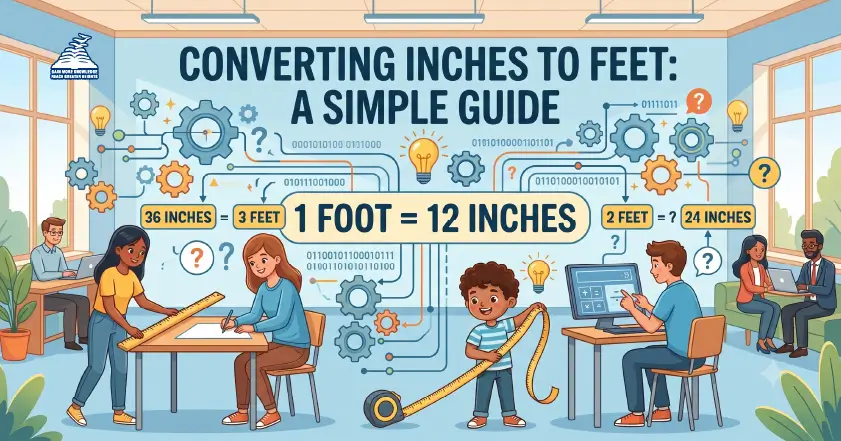
The basic rule is easy to remember: 12 inches make 1 foot. For example, if a stick is 24 inches long, it is equal to 2 feet because 24 ÷ 12 = 2. This rule is the foundation for all inch and foot measurement problems.
Step-by-Step Method for Inch to Feet Conversion
To Convert Inches to Feet, students can follow three simple steps. First, write the measurement given in inches. Second, divide the value by 12. Third, write the answer in feet. This method helps students understand the process clearly.
Example:
Convert 36 inches into feet.
36 ÷ 12 = 3
So, 36 inches = 3 feet.
Easy Inch to Feet Conversion Examples
Understanding inch to feet becomes easier with regular examples. If a table is 48 inches long, then 48 ÷ 12 = 4 feet. If a chart is 60 inches wide, then 60 ÷ 12 = 5 feet. Such examples help students connect measurement learning with real objects.
Common Inch to Feet Conversion Chart
An Inches to Feet Chart is useful for quick revision. Students can use this chart while solving homework, worksheets, classroom activities, and measurement-based questions.
| Inches | Feet |
| 12 inches | 1 foot |
| 24 inches | 2 feet |
| 36 inches | 3 feet |
| 48 inches | 4 feet |
| 60 inches | 5 feet |
| 72 inches | 6 feet |
| 84 inches | 7 feet |
| 96 inches | 8 feet |
| 108 inches | 9 feet |
| 120 inches | 10 feet |
Difference Between Inches and Feet Explained Simply
Inches and feet both measure length, but they are used for different sizes. Inches are useful for smaller objects such as pencils, books, toys, and screens. Feet are useful for larger measurements such as room size, height, furniture length, and playground spaces.
| Point of Difference | Inch | Foot |
| Size | Smaller unit | Larger unit |
| Short Form | in | ft |
| Value | 1 inch | 12 inches |
| Common Use | Small objects | Bigger lengths and heights |
| Example | Pencil length | Room height |
Where Inch to Feet Conversion Is Used in Daily Life
In the best CBSE schools in Bangalore, students often learn measurement through classroom activities, worksheets, lab work, sports ground marking, and project-based learning. This makes the concept practical and easy to understand.
Tips to Remember Inch to Feet Conversion Easily
The top CBSE schools in Bangalore encourage students to use simple memory tricks for measurement topics. The most important trick is to remember that 12 inches make 1 foot. Once this is clear, students can solve most conversion questions easily.
Helpful tips include:
- Remember 12 inches = 1 foot
- Divide by 12 to find feet
- Use a ruler or measuring tape for practice
- Start with simple values like 12, 24, and 36
- Practise with real objects at home or school
- Make a small conversion chart for revision
Learning Measurements Through Simple Conversion Methods
The top-rated schools in Bangalore focus on building strong foundational maths skills through examples, activities, and real-life applications. When students learn measurement conversions step by step, they understand maths as a useful life skill rather than just a classroom subject.
Why Students Should Practise Measurement Conversion
Measurement conversion helps children become more accurate in maths and daily activities. It also supports learning in science, craft, drawing, construction-related projects, sports, and practical problem-solving. Regular practice helps students avoid confusion between smaller and larger units.
Making Measurement Conversion Simple for Students
Learning Inch to Feet conversion helps students understand measurements clearly and apply them in everyday situations such as measuring height, length, classroom objects, charts, and project materials. At Presidency School Bangalore East, students are guided to learn mathematical concepts through simple explanations, practical examples, and activity-based learning. Since 12 inches make 1 foot, children can easily convert inches into feet by dividing the inch value by 12. By making measurement learning simple, useful, and relatable, Presidency School Bangalore East helps students build strong calculation skills, problem-solving ability, and confidence in applying mathematics to real-life situations.
Conclusion
Converting inches into feet is simple when students remember the basic rule: 12 inches make 1 foot. To change inches into feet, divide the number of inches by 12. With charts, examples, practice questions, and real-life activities, students can learn this conversion easily. Strong measurement skills help children perform better in maths and understand daily measurements with greater confidence.
FAQs:
How many inches are there in 1 foot?
What is the formula to convert inches into feet?
How do you convert 60 inches into feet?
60 ÷ 12 = 5 feet.